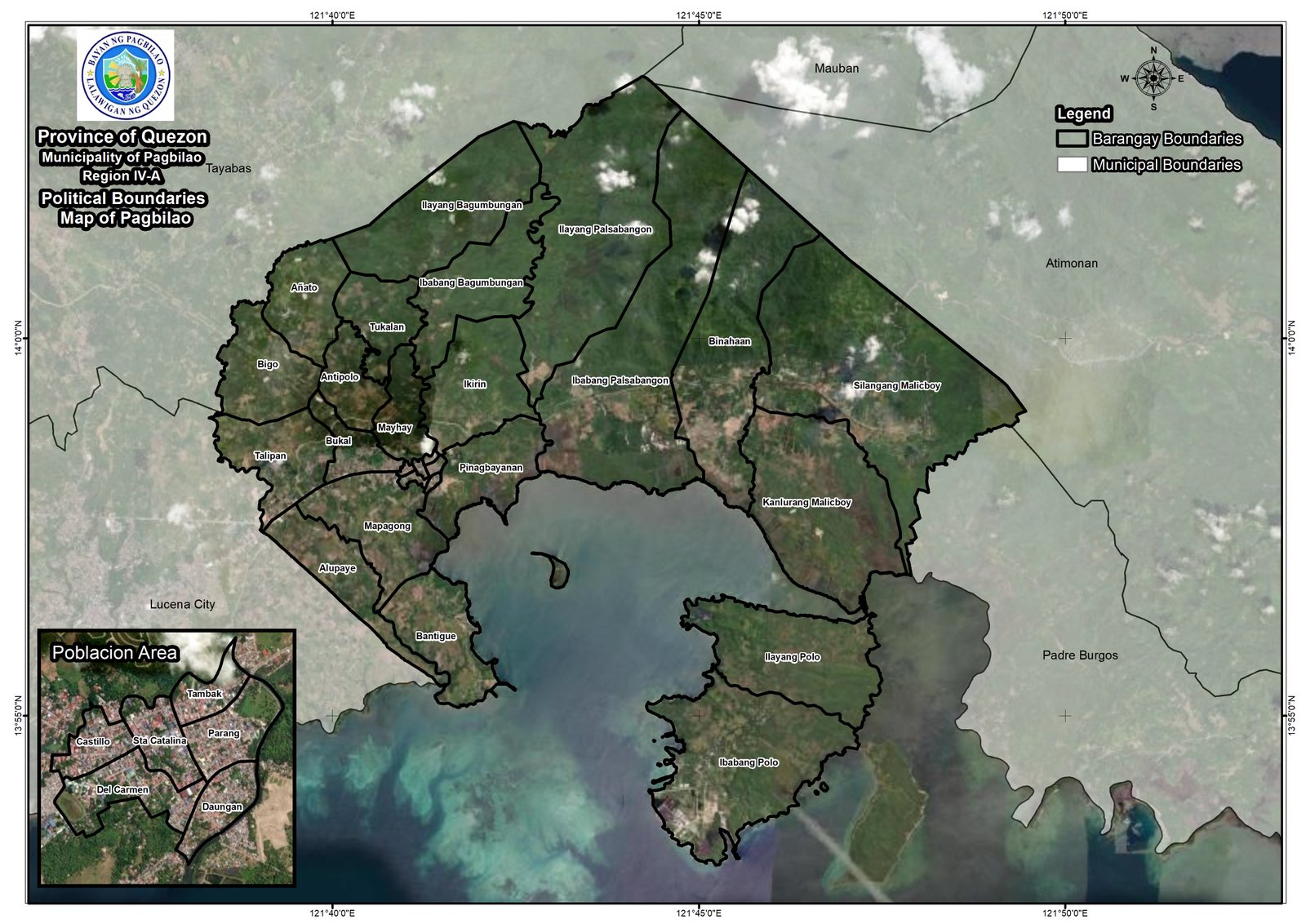
Major infrastructure during the year under review included the construction of a bridge in Ilayang Bagumbungan, giving residents convenient access to and from the area even during heavy rains without fear of rising water and strong currents. Vehicles can readily reach the connecting areas of Ibabang and Ilayang Bagumbungan.
Other major infrastructure included the completion of the Sentrong Pangkalusugan and Sentrong Pangkabuhayan, as well as the public markets located in Barangay Sta. Catalina and Del Carmen, respectively.
The Ecological Park added a second lagoon to accommodate the increasing volume of solid waste generated in the municipality.
98.5421 haTotal road-network area
14.4454 haUrban-road area
84.0967 haRural-road area
3.3114 haPNR railway area
The total road network covers 98.5421 hectares, about 17.00% of the total built-up area or 0.56% of the total land area. With a width of four meters, urban roads occupy 14.4454 hectares, or 14.70% of the total area covered by roads.
The remaining roads, classified by administrative level, are spread throughout the municipality's barangays. Their widths vary from four meters for barangay roads, eight meters for provincial roads, and ten meters for national roads. Rural roads cover 84.0967 hectares, or 85.34% of the total area occupied by roads. The Philippine National Railways line traversing the municipality occupies 3.3114 hectares.
Transportation
Pagbilao is strategically located at the heart of Quezon Province and serves as a link between the Bondoc Peninsula and Bicol Region and the provincial capital, Lucena City. Bicol-bound buses pass through the municipality, which can be reached from Manila in approximately two to three hours. Common terminals are situated at the Grand Terminal in Lucena City.
Temporary jeepney terminals in Pagbilao serve routes including Lucena City, Barangay Bigo, Silangang Malicboy, and Grande Island. Jeepneys travel daily to and from Lucena City until 9:00 p.m., while Bicol-bound buses also serve Pagbilao after 9:00 p.m. All barangays are accessible by land transportation, although the last trip to Barangay Ibabang Polo is at 5:00 p.m.
Road Network
Pagbilao is accessible by land and water transportation. The Daang Maharlika via Old Zigzag Road, together with the newer diversion road, is considered a national highway. Pagbilao-Tayabas Road is a provincial road, making entry to the municipality possible from multiple directions.
Provincial and national roads traversing the poblacion facilitate the movement of goods and services and support trade activities in rural areas.
Social Service Facilities, Utilities, and Amenities
Under the Local Government Code of 1991, the Social Welfare and Development Office formulates measures for Sanggunian approval and provides technical assistance and support to the governor or mayor in delivering basic social-welfare services and adequate facilities. The office facilitates protection and rehabilitation for socially disadvantaged persons and persons with physical or mental disabilities, while providing integrated welfare services responsive to community needs.
The Office on Social Welfare and Development Services, headed by the Municipal Social Welfare and Development Officer, was created under Republic Act No. 7160.
The LGU funded a day-care center for the elderly under RA 7876, along with the construction, maintenance, and improvement of thirty-one day-care centers for preschoolers under RA 6972. A Training and Production Center was also provided for women, youth, and other unskilled or economically unproductive individuals, with thirty sewing units and related training equipment and accessories.
Agriculture
The pronounced rainy season contributes significantly to the municipality's agricultural production. Agriculture has traditionally been Pagbilao's economic base and occupies the largest land-use category: 12,381.252 hectares, or 69.71% of the total land area.
Coconut is the municipality's major agricultural cash crop. Philippine Coconut Authority data identifies 5,562.3200 hectares, or 44.92535% of agricultural land, as devoted to crop production, while coconut plantations cover 31.32% of the municipality's total land area.
Irrigated lowland rice fields cover 2,453.2500 hectares, or 19.814% of agricultural areas and 13.81% of the municipality's total land area. These areas are harvested twice yearly, averaging 95 cavans per hectare during the wet season and 50 cavans per hectare during the dry season. These figures remain below the standard yield of 100 to 150 cavans per hectare, possibly due to inadequate agricultural support facilities, financing, and traditional farming practices. Rice lands are regarded as prime agricultural lands and are non-negotiable for conversion to non-agricultural uses.
Other crops include vegetables, banana, citrus, mango, rambutan, corn, and root crops. They occupy 1,245 hectares, or 10.06% of agricultural areas and 7% of the total land area. Selective conversion of coconut and other vegetable areas may be considered per project; these areas fall under the National Protected Agricultural Areas System.
Breakwaters and fishponds account for 1,092.6800 hectares of agricultural activity, while another 2,028 hectares are devoted to the Special Agricultural and Fisheries Development Zone.
Water Supply
The Quezon Metropolitan Water District is Pagbilao's main source of potable water. Other sources include rainwater, open wells, and natural springs located throughout the municipality, together with piped-water and watershed areas. Rural barangays also obtain potable water from natural sources, commercial faucets, and other means.
Power
Pagbilao is known as the power capital of Southern Luzon. TeaM Energy Philippines generates 750 MW of electricity through the coal-fired thermal power plant, while electricity distribution in the municipality is provided by Manila Electric Company (MERALCO).
The municipality is described as 100% energized, meaning electricity has reached all barangays. Households beyond secondary distribution lines may remain without individual connections, while those far from primary lines receive support through TeaM Energy and the Department of Energy's ER-94 program. The LGU also provides solar posts and solar lights to distant barangays beyond MERALCO service.
At the time of the source report, approximately 42.3%, or 5,202 rural households, remained unserved. The planning projection anticipated universal household electrification by 2022. For cooking fuel, about 14.46%, or 2,151 households, used liquefied petroleum gas, while many households continued to use wood.
Communications
Pagbilao's proximity to Lucena City and Manila has made communication important to local development. The municipality has telephone services, a radio satellite station, newspapers, magazines, and other communication channels.
Digitel was acquired by PLDT in early 2012, placing the municipality within the company's landline network. Globe, Smart, Sun, and Alcatel also provide telecommunications services.
There is no local print medium apart from a religious publication circulated weekly, although national broadsheets, tabloids, and magazines circulate daily.
Postal Services
The Philippine Postal Corporation office is located on Alvarez Street in a rented private establishment and is staffed by one employee. It serves six poblacion barangays and twenty-one rural barangays. Letters are delivered on schedule, with Barangays Polo and Malicboy visited once weekly. One letter carrier uses a motorcycle, while mail received from elsewhere in the Philippines and abroad is delivered daily by van. Outgoing mail is collected for the Lucena Sub-distribution Center.
Solid Waste
Solid-waste generation is directly related to population. According to the source report, 4,118 households, or 42.27%, had waste collected by service garbage trucks, while 2,742 households, or 28.14%, disposed of waste in a sanitary landfill. Collection equipment included seven garbage trucks, one bulldozer, one compactor, and one loader. Urban barangays received collection twice weekly for biodegradable and non-biodegradable waste, while special wastes were collected separately each week.
An existing six-hectare ecological park in Barangay Ibabang Bagumbungan operates in accordance with RA 9003. Facilities and equipment for processing residual waste support solid-waste management, including a segregating machine that expedites waste separation and processes for producing bricks and monobloc chairs.
The Municipal Environment and Natural Resources Officer oversees planning and monitoring of solid-waste management activities. A Public Services Officer supervises residual-waste collection with twenty-five personnel.
Toilet and Sanitation Facilities
Toilet facilities are a basic household need. As of 2012, the source report recorded 6,807 households, or 69.87%, with sanitary toilets; 872, or 8.95%, with unsanitary toilets; and 2,062, or 21.16%, without toilets. The target for toilet-bowl distribution was 2,934 households, or 30.11% of municipal households.
Distribution began in 1995 as part of the former Human Ecological Security program and was intended for completion in 2000. Continuing demand led the local chief executive to include it in the regular sanitation program.